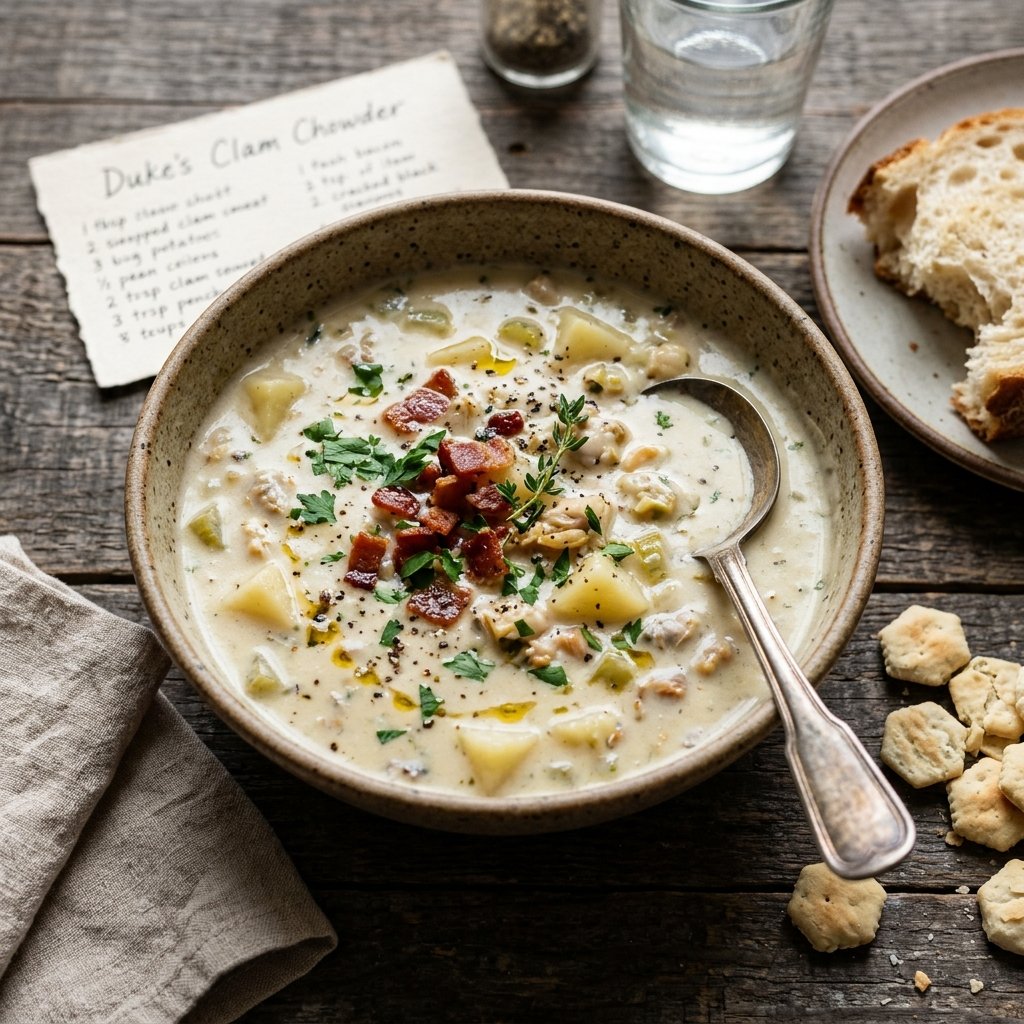
Some chowders are thick enough to stand a spoon in. Others taste mostly of flour and cream. The one served at Duke’s Seafood in the Seattle area sits in a different place: creamy but pourable, with a clear clam flavor and a surprising amount of fresh herbs. This Duke’s clam chowder recipe follows the version the restaurant shared publicly, adapted slightly for a home kitchen, so you can make a big pot of it without a commercial stove or a trip to Puget Sound.
Below you’ll find the full ingredient list, the reasoning behind the slightly unusual steps (a timed roux, a specific simmer temperature), clam options for every budget, a gluten-free route, and storage advice. The printable recipe card is at the bottom.
What Makes Duke’s Clam Chowder Different
Duke’s Seafood is a three-time winner of the Seattle Chowder Cook-Off, and the recipe was printed in the restaurant’s cookbook, As Wild As It Gets: Duke’s Secret Sustainable Seafood Recipes. Read through it and a few details stand out compared with a typical New England-style chowder:
- Five fresh herbs. Thyme, basil, marjoram, parsley and dill all go into the pot. Most chowders stop at a bay leaf and some thyme. The dill in particular gives Duke’s its bright, almost Scandinavian edge, which fits a Pacific Northwest seafood house.
- Clam base plus clam juice. Bottled clam juice alone can taste thin. A spoonful of concentrated clam base deepens the broth so the clams don’t have to do all the work.
- A roux cooked for exactly 7 minutes. Long enough to remove the raw flour taste, short enough that the roux stays pale and the chowder stays creamy white.
- Controlled heat. The recipe gives target temperatures instead of “bring to a boil.” Dairy and clams both suffer at a hard boil, so the chowder is kept below simmering point.
- A rest before serving. The chef’s own advice is that the chowder tastes better after it sits on low heat for a few hours, once the herbs have had time to bloom.
None of these steps is difficult. They just reward a little patience, which is the real secret behind this one.
Ingredients for Duke’s Clam Chowder Recipe
The original makes about three-quarters of a gallon, roughly 12 cups, which serves eight generously. The quantities here match the restaurant version; the notes explain where you have flexibility.
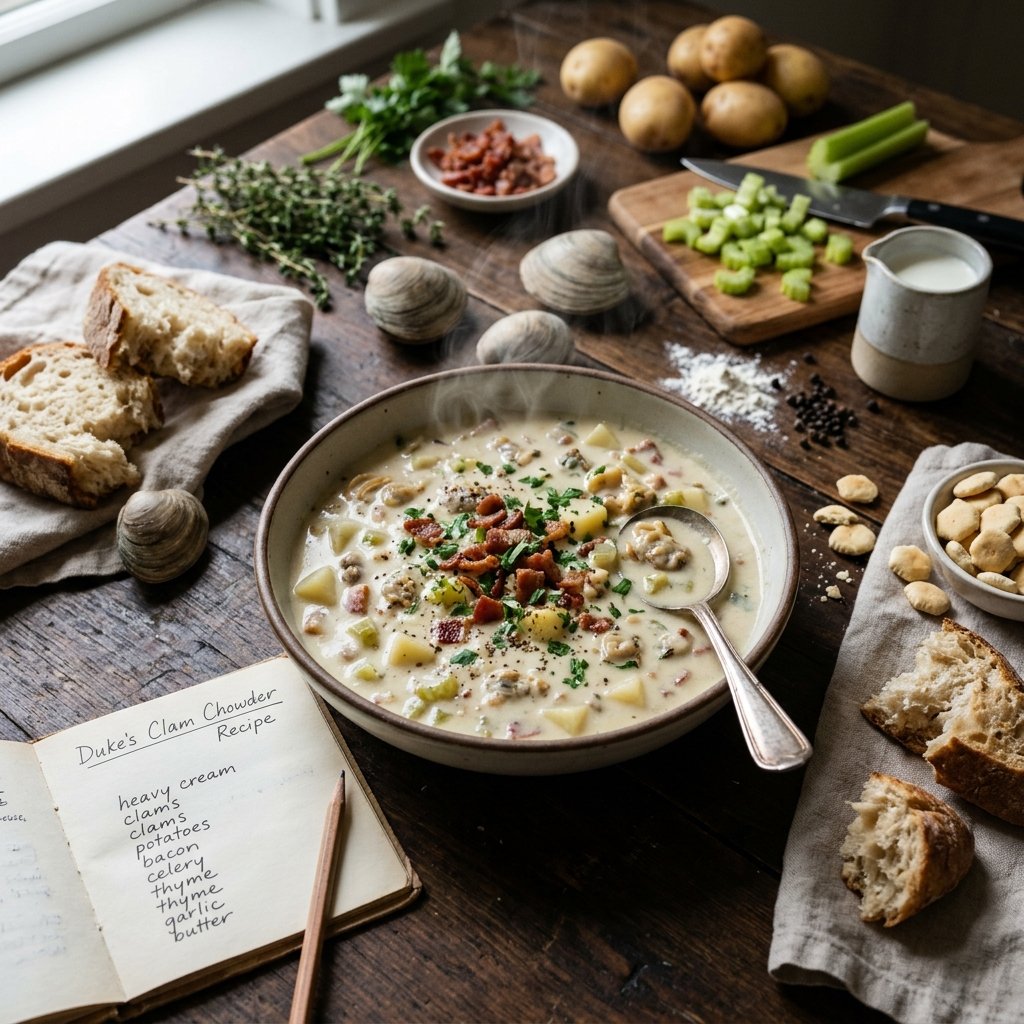
The base
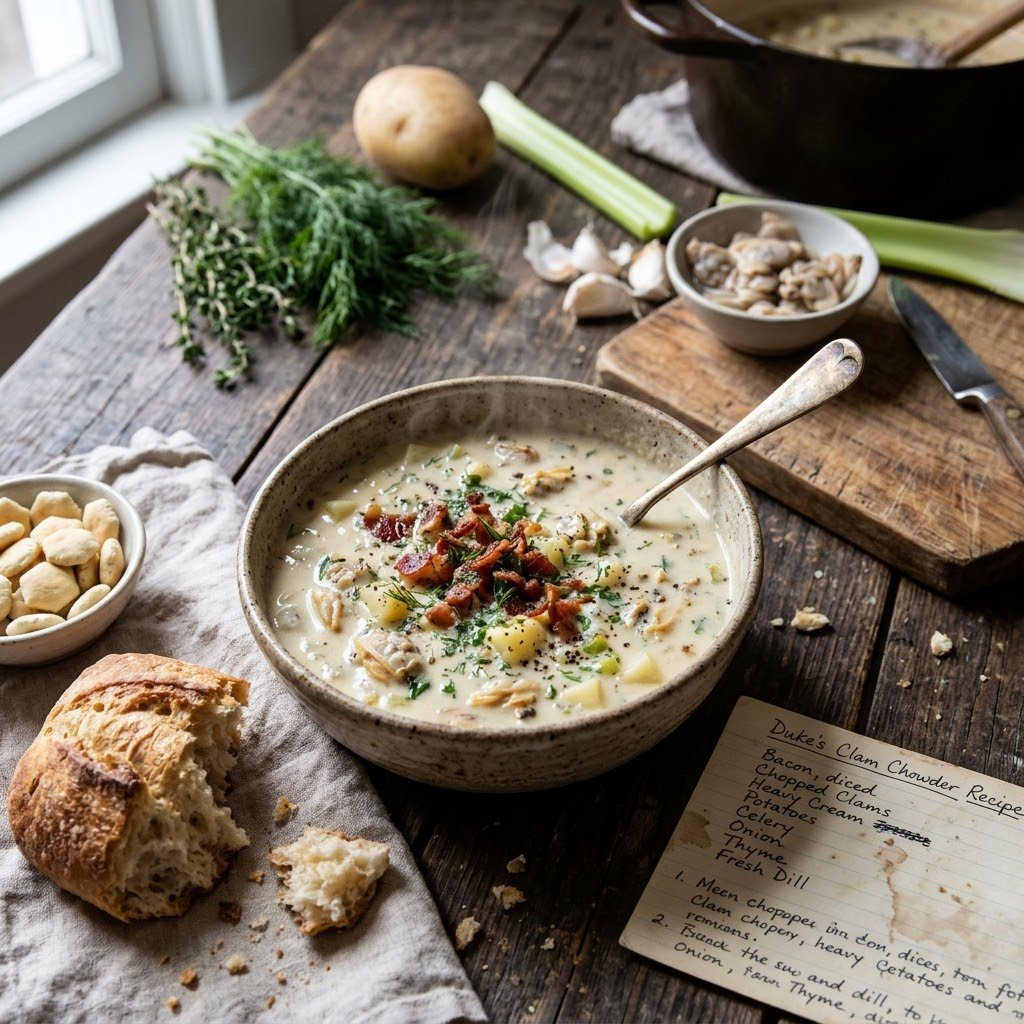
- 2 cups red potatoes, diced medium. Waxy red potatoes hold their shape; russets will break down and thicken the soup more than you might want.
- 4 slices bacon, chopped. The restaurant uses nitrite-free bacon. Any good smoked bacon works.
- 1/2 cup butter. Unsalted gives you more control, since clam base is already salty.
- 2 cups onion and 2 cups celery, diced medium. That is a lot of celery compared with many chowders. It adds texture and a fresh, savory note, so don’t cut it back.
- 1 tablespoon garlic, finely chopped.
- 1/2 cup flour for the roux, or a gluten-free blend (see below).
The liquid
- 2 tablespoons clam base. Look for a jarred clam base in the soup aisle or online. If you can’t find one, see the substitutions section.
- 1 1/2 cups clam juice.
- 1 1/2 cups milk and 2 1/2 cups heavy whipping cream.
- 1 pound chopped clams. Duke’s uses individually quick-frozen surf clams.
Herbs and seasoning
- 1 teaspoon fresh thyme leaves
- 1/2 teaspoon fresh basil
- 1/2 teaspoon marjoram, fresh or dried
- 2 tablespoons fresh parsley
- 1 tablespoon fresh dill
- 1/2 teaspoon black pepper
Chop all the herbs finely and keep them together in one small bowl so they go in at the same moment.
Equipment You’ll Need
- A heavy-bottomed pot or Dutch oven, at least 5 quarts. Thin pots scorch cream-based soups easily.
- A whisk, for lump-free roux and dairy.
- An instant-read thermometer. Optional, but it makes the roux and simmer steps foolproof.
- A separate saucepan for the potatoes.
How to Make Duke’s Clam Chowder Step by Step
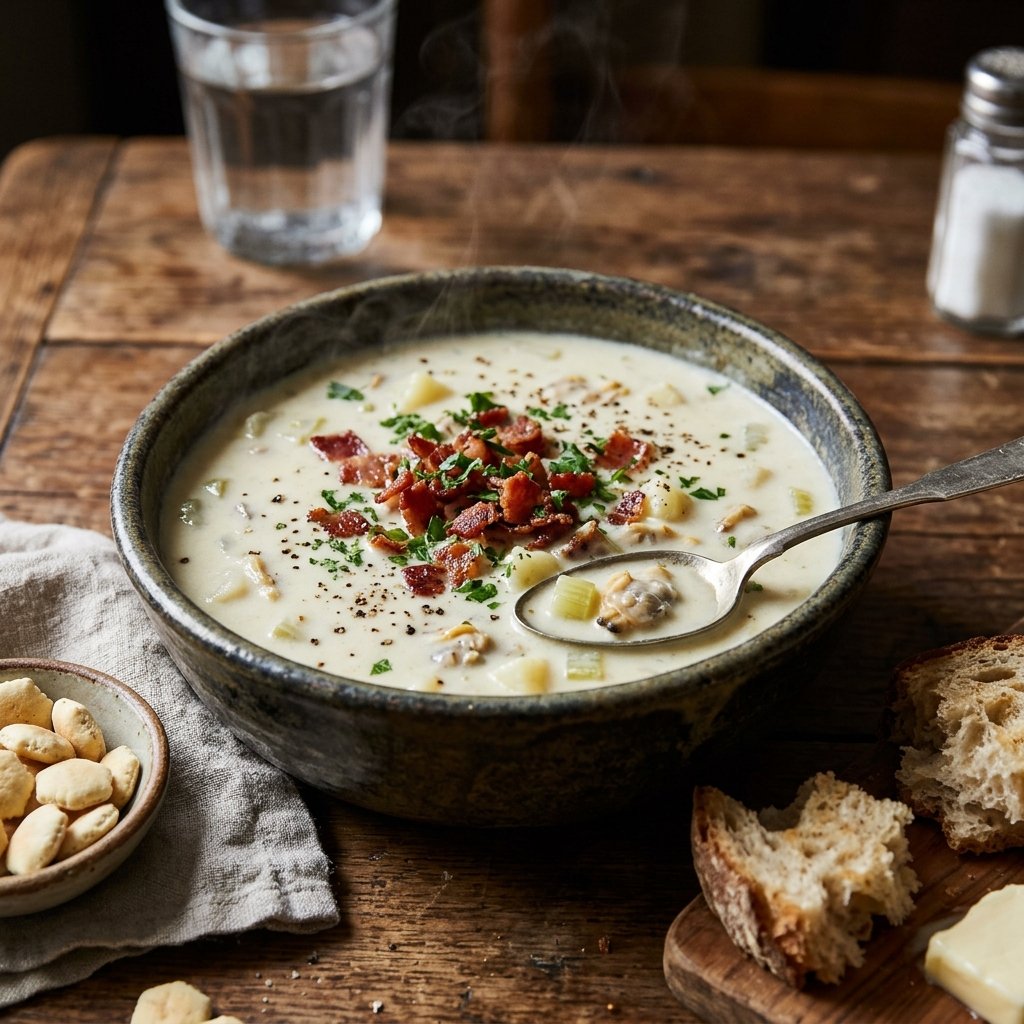
1. Par-cook the potatoes
Boil the diced potatoes in salted water until a knife slides in with a little resistance, about 8 to 10 minutes. Drain and set them aside. Cooking them separately keeps their starch from clouding the base and lets you add them at the end, so they stay in neat cubes.
2. Render the bacon
Cook the chopped bacon in your heavy pot over medium heat until crisp. Leave the fat in the pot; it is part of the flavor foundation. If you’d like crisp bacon for garnish, lift out a spoonful now and add it back on top of each bowl.
3. Soften the vegetables
Add the butter, onion, celery and garlic. Stir and cook gently until the onion is translucent and the celery has softened, about 6 to 8 minutes. You don’t want color here, so lower the heat if anything starts to brown.
4. Build the roux
Sprinkle the flour over the vegetables and stir until no dry flour remains. The restaurant method is to keep stirring until the mixture reaches about 175°F, then cook it for 7 minutes. It will look like a thick, pale paste coating the vegetables. Keep it moving so it doesn’t stick.
5. Add the clam liquid
While the roux cooks, whisk the clam base into the clam juice in a bowl until fully dissolved. Pour this into the pot a little at a time, whisking constantly. Adding liquid only after the roux has cooked is what prevents the small, stubborn flour lumps that can ruin a chowder’s texture.
6. Add dairy and herbs
Whisk in the milk and cream, then stir in all the herbs and the black pepper. Bring the chowder up to about 185°F, whisking frequently. That is a bare simmer: small bubbles at the edges, no rolling boil.
7. Finish with potatoes and clams
Add the potatoes and clams and hold the chowder at that gentle heat for 2 to 3 minutes, just long enough for everything to heat through. Clams turn rubbery fast, so this last step is short. Taste and adjust with pepper or a pinch of salt. Serve between 165°F and 175°F.
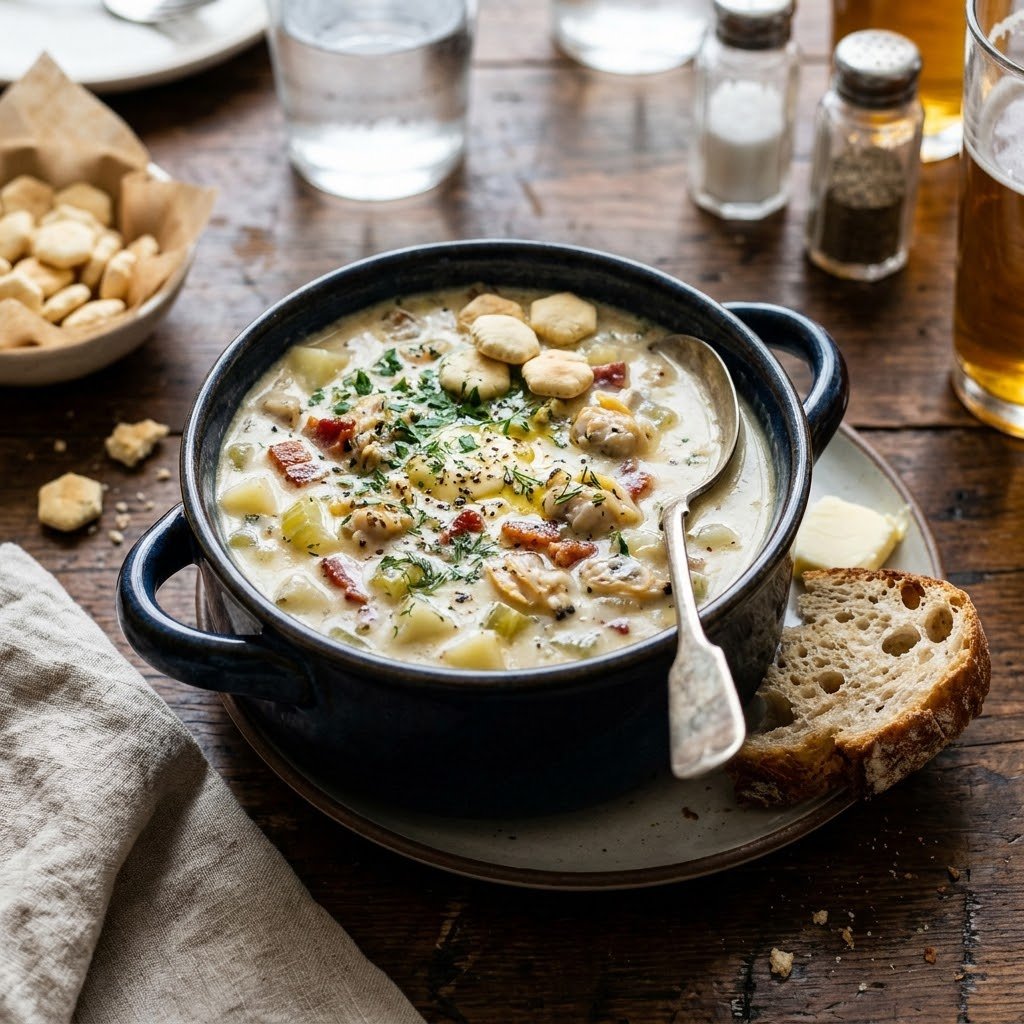
Why the 7-Minute Roux Matters
A roux thickens because the starch in flour swells when it meets hot liquid. Cooking the flour in fat first coats each particle, so it disperses smoothly instead of clumping. Undercook it and the chowder can taste chalky. Cook it too long and it turns tan and nutty, which suits gumbo but muddies a white chowder.
Seven minutes at moderate heat is the middle ground. If you don’t have a thermometer, aim for a roux that smells toasty rather than raw and still looks ivory. Set a timer; it’s easy to cut this step short.
Choosing Your Clams
The clam you use changes the cost and the flavor more than any other ingredient. All three of these work in a Duke’s clam chowder recipe:
- Frozen surf clams are what the restaurant uses. They are sold chopped, cook in minutes, and are consistent. Thaw them in the fridge and add them with any liquid in the bag.
- Canned chopped clams are the easiest to find. You’ll need about three 6.5-ounce cans for a pound of clam meat. Drain them, but keep the liquid and use it as part of your 1 1/2 cups of clam juice.
- Fresh clams such as littlenecks or Manila clams give the cleanest flavor. Steam about 4 pounds in the shell with a splash of water until they open, discard any that stay closed, then chop the meat. Strain the cooking liquid through a coffee filter to remove grit and use it in place of some bottled clam juice.
If you like fresh shellfish, our drunken clams recipe is a good way to use any extra clams you bring home.
Substitutions and Variations
- No clam base? Use 1 1/2 cups extra clam juice in place of the same amount of milk, and add 1 teaspoon of fish sauce or anchovy paste for depth. The chowder will be slightly less rich but still well-balanced.
- Lighter version: Replace up to half the cream with whole milk. Expect a thinner chowder; simmer a few minutes longer to compensate.
- No bacon: Start with an extra 2 tablespoons of butter and add a pinch of smoked paprika for a hint of smoke.
- Missing an herb? Dried herbs work at about one-third the fresh amount, but keep the parsley and dill fresh if you can. They carry most of the fresh flavor.
- Add corn: A cup of sweet corn kernels with the potatoes makes it closer to a seafood corn chowder.
How to Make It Gluten-Free
Duke’s offers gluten-free chowder, made by swapping wheat flour for a blend of rice flours, potato starch, sorghum flour and tapioca starch. At home, the simplest route is a store-bought 1-to-1 gluten-free flour blend used in the same 1/2-cup amount. Gluten-free flours can thicken a little differently, so add the clam liquid slowly and whisk well. Check your clam base and bacon labels too, since some contain wheat-based additives.
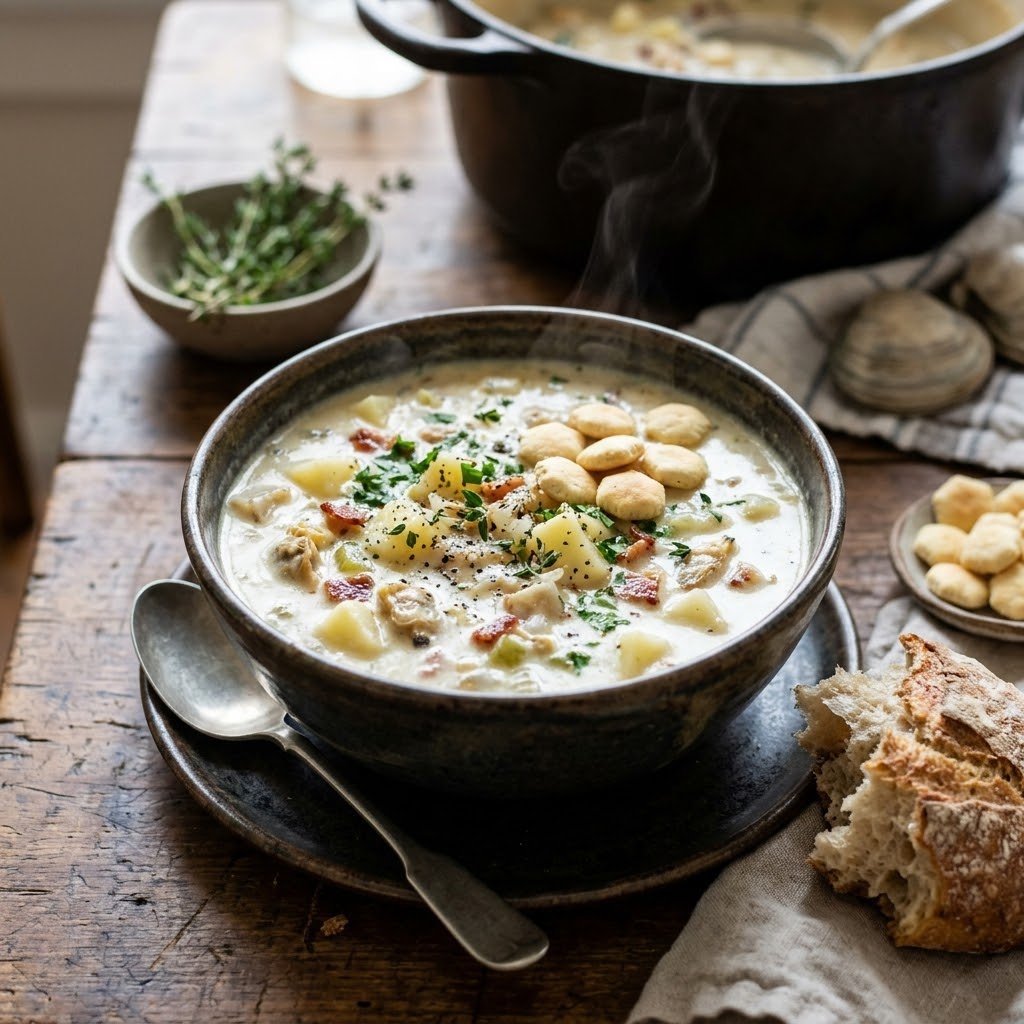
Let It Rest: The Secret Most Copycats Skip
The chef behind the recipe recommends letting the chowder sit on very low heat for a few hours before serving. During that time the herbs soften and release their flavor into the cream, and the clam, bacon and vegetables blend into one rounded taste. Freshly made chowder is good; rested chowder is noticeably better.
If you can’t hold it for hours, make it a day ahead. Chill it quickly (see storage below), then reheat gently the next day. The overnight rest does the same job.
What to Serve with Clam Chowder
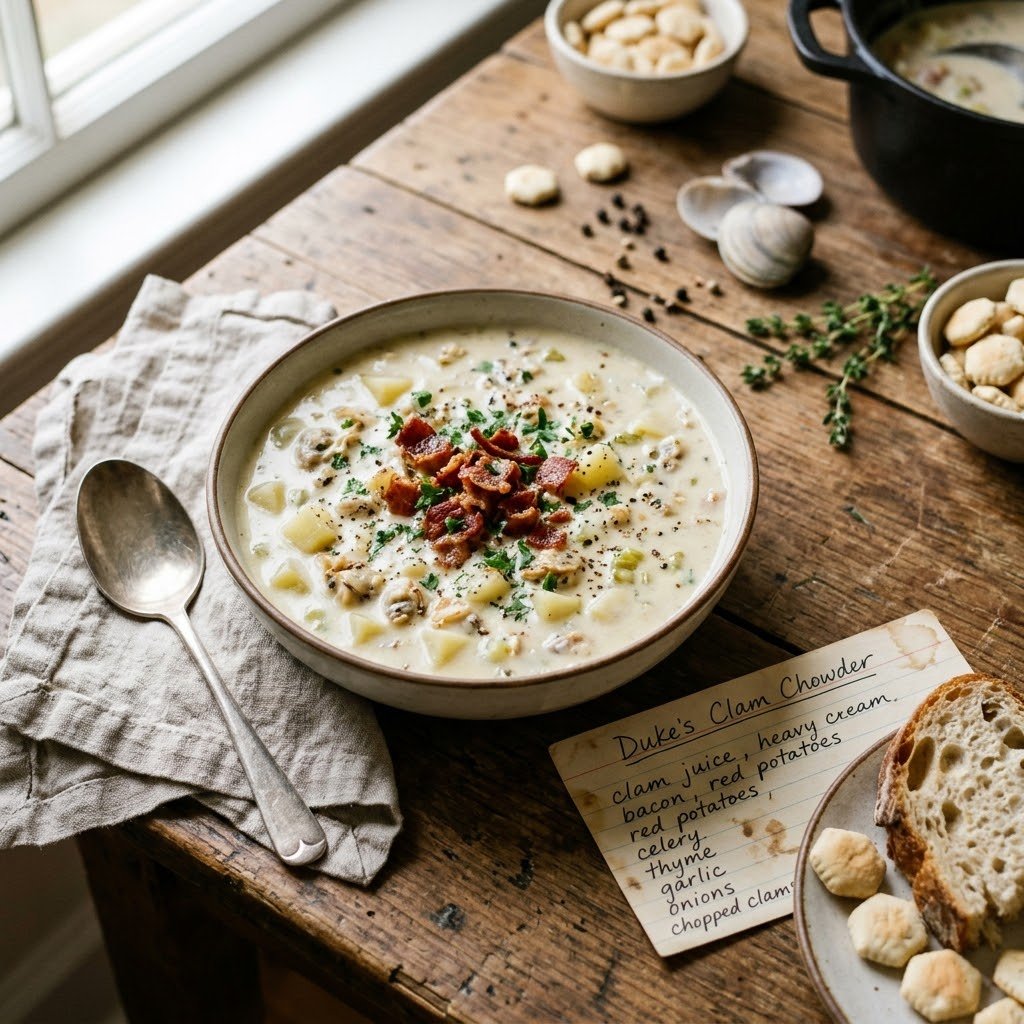
- Oyster crackers or saltines, the classic choice.
- A crusty sourdough loaf, or a hollowed-out sourdough bread bowl for the full waterfront experience.
- A crisp green salad with a sharp vinaigrette to cut the richness.
- Something warm and cheesy, such as our crabbies recipe with crab and cheddar on English muffins.
For a soup night with more than one pot, a lighter broth-based option like our coconut lime fish soup or the hearty Tuscan ribollita makes a good contrast.
Storing and Reheating
Cream soups need to cool quickly. The restaurant’s tip is to pour leftover chowder into a shallow pan, about 2 inches deep, so it drops below 41°F fast. At home, divide it into shallow containers and refrigerate within 2 hours of cooking. It keeps for 3 to 4 days, in line with the FoodSafety.gov cold storage guidelines for soups and leftovers.
Reheat over low heat, stirring often, until steaming. Avoid a boil and avoid long microwave blasts, both of which can toughen the clams and split the cream. If the chowder has thickened in the fridge, loosen it with a splash of milk.
Freezing isn’t ideal. Potatoes turn grainy and the cream can separate when thawed. If you want to freeze it, make the base without potatoes, freeze that, and add freshly cooked potatoes when reheating.
Troubleshooting Common Problems
- Lumpy chowder: The liquid went in too fast or before the roux was cooked. Whisk vigorously, or blend a cup of the base and stir it back in.
- Too thick: Add milk or clam juice a quarter cup at a time.
- Too thin: Simmer gently for a few more minutes, or mash a few potato cubes against the side of the pot.
- Too salty: Clam base and bacon both add salt. Add more milk and cream, or a few extra potatoes, and avoid salting until the end next time.
- Curdled or grainy: The heat was too high. Take the pot off the heat and whisk; prevention is keeping it below a boil.
- Rubbery clams: They cooked too long. Next time add them in the final 2 to 3 minutes only.
Duke’s Clam Chowder Recipe FAQ
Is this the official Duke’s recipe?
It is based on the recipe Duke’s published in its cookbook and shared with Seattle media, adapted for home cooks. This site isn’t affiliated with the restaurant, and its kitchen may adjust the recipe over time.
Is Duke’s chowder New England style?
It is a cream-based white chowder, so it belongs to the New England family, but the generous fresh herbs, especially dill, give it a distinct Pacific Northwest character.
Can I make it in a slow cooker?
Make the roux and base on the stove, since a slow cooker can’t cook a roux properly. Then move the base to a slow cooker on low or warm to rest for a few hours. Add the potatoes and clams in the last 15 minutes.
Can I halve the recipe?
Yes. All the quantities scale down cleanly. Keep the roux cooking time the same.
Why is my chowder grey instead of white?
Browned vegetables or an over-darkened roux will tint it. Cook the onions and celery gently and keep the roux pale.
Make It Once, Then Make It Your Own
Once you’ve cooked this Duke’s clam chowder recipe as written, it’s easy to adjust: more dill if you love it, a little cayenne for warmth, extra clams for a special occasion. Just keep the gentle heat and the rest time, because those two habits are what turn a decent pot of chowder into a really good one.
Duke’s Clam Chowder
Ingredients
Chowder base
- 2 cups red potatoes diced medium, skin on
- 4 slices bacon nitrite-free, chopped
- 1/2 cup unsalted butter
- 2 cups yellow onion diced medium
- 2 cups celery diced medium
- 1 tbsp garlic finely chopped
- 1/2 cup all-purpose flour or a gluten-free flour blend
- 2 tbsp clam base
- 1 1/2 cups clam juice
- 1 1/2 cups whole milk
- 2 1/2 cups heavy whipping cream
- 1 lb chopped clams frozen surf clams, or canned chopped clams, drained
Herbs and seasoning
- 1 tsp fresh thyme leaves only, chopped
- 1/2 tsp fresh basil chopped
- 1/2 tsp marjoram fresh or dried
- 2 tbsp fresh parsley chopped
- 1 tbsp fresh dill chopped
- 1/2 tsp black pepper
Instructions
- Boil the diced potatoes in salted water until just tender, about 8 to 10 minutes. Drain and set aside.
- In a heavy-bottomed pot over medium heat, cook the chopped bacon until crisp.
- Add the butter, onion, celery and garlic. Cook, stirring, until the vegetables are soft but not browned, about 6 to 8 minutes.
- Sprinkle in the flour and stir to form a roux. Keep stirring until it reaches about 175°F, then cook for 7 minutes without letting it brown.
- In a bowl, whisk the clam base into the clam juice until dissolved. Pour it into the roux gradually, whisking constantly until smooth.
- Whisk in the milk and cream, then add all the herbs and the pepper. Heat to about 185°F, whisking often. Do not let it boil.
- Add the potatoes and clams and simmer gently for 2 to 3 minutes, until the clams are hot. Serve at 165 to 175°F, or keep it on very low heat for an hour or more to let the herbs bloom.