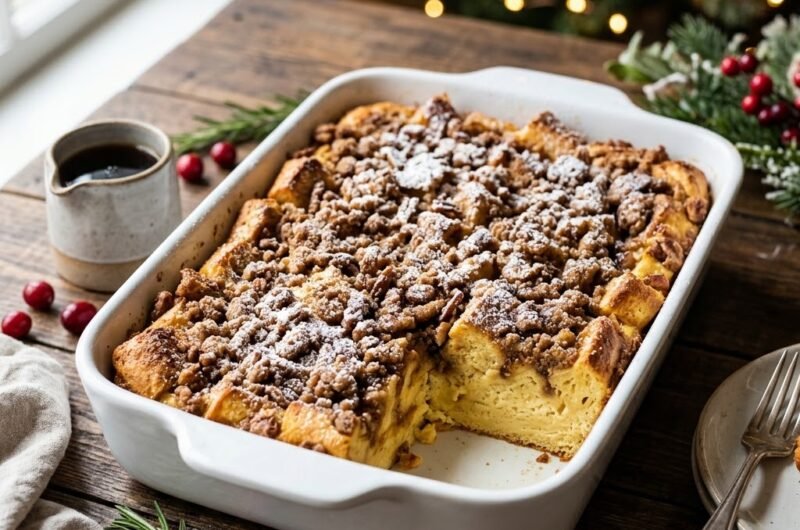
This eggnog french toast casserole is the breakfast you put together the night before and bake while everyone opens presents. Thick cubes of challah soak overnight in an eggnog custard spiced with nutmeg and cinnamon, then bake under a brown sugar and pecan crumble until the top is crisp and the middle is soft and set, not wet.
It feeds a table of ten to twelve, it uses up the carton of eggnog that always seems to be open in December, and the morning work is turning on the oven. Below you will find the full recipe card, the reasons behind each ingredient, a make-ahead timeline, and fixes for the two problems people run into most: a soggy center and a dry top.
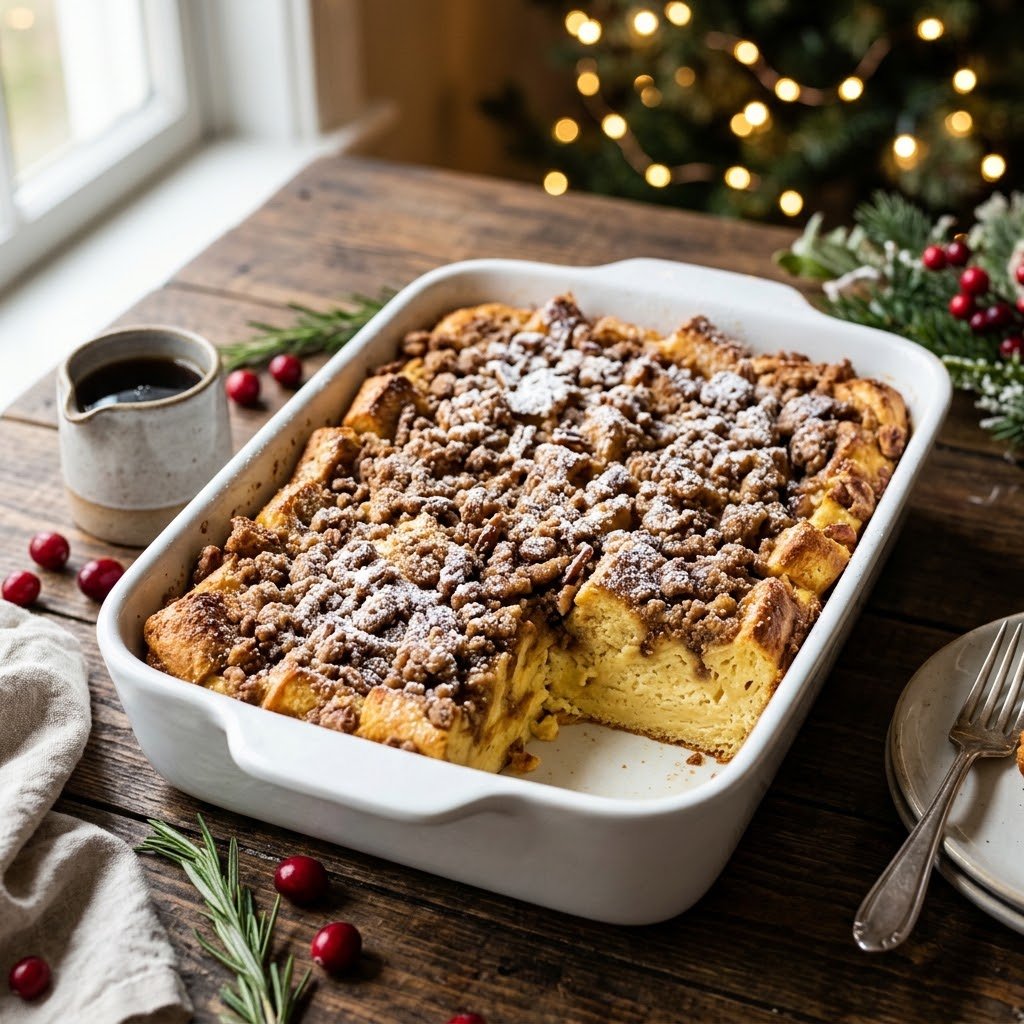
Eggnog French Toast Casserole at a Glance
| Detail | What to expect |
|---|---|
| Pan | 9×13-inch baking dish |
| Servings | 10 to 12 |
| Hands-on time | About 20 minutes |
| Soak time | At least 4 hours, best overnight (8 to 12 hours) |
| Bake time | 45 to 55 minutes at 350°F |
| Texture | Custardy inside, crisp crumble on top |
Why Eggnog Works So Well in French Toast
French toast custard is usually eggs, milk, sugar and spice. Store-bought eggnog is already most of that: milk, cream, sugar, egg yolks and nutmeg in one carton. Using it as the liquid gives you a richer custard without measuring five extra things, and it tastes like the holidays without tasting like a drink.
Because eggnog is thicker and sweeter than milk, the recipe adds a little plain milk to loosen it so it soaks into the bread evenly, and it keeps the extra sugar in the custard low. Most of the sweetness lives in the crumble on top, where it caramelizes instead of making the inside heavy.
Ingredients and Why Each One Matters
The bread
Challah or brioche is the first choice. Both are enriched with eggs and butter, so they soak up custard and stay tender instead of turning to paste. A sturdy French loaf also works and gives a chewier result. Whatever you use, it should be a day or two old, or dried in the oven for 10 minutes at 300°F. Fresh, soft bread collapses during the overnight soak, and that is the main cause of a soggy casserole.
Cut the bread into 1 to 1½-inch cubes. Smaller pieces turn into bread pudding; bigger ones leave dry centers.
The custard
- Eggnog: full-fat, regular eggnog gives the best flavor. Light eggnog works but the casserole will be less rich.
- Eggs: eight large eggs set the custard. Fewer eggs and the middle stays loose.
- Milk: half a cup thins the eggnog so it moves into the bread.
- Brown sugar, vanilla, cinnamon, nutmeg and salt: small amounts that round out the eggnog flavor. Freshly grated nutmeg is noticeably stronger than ground.
- Rum or bourbon (optional): two tablespoons, for an adults-only brunch. Rum extract is the alcohol-free swap.
The pecan crumble
Flour, brown sugar, cinnamon, cold butter and chopped pecans. You make it the night before and keep it in a separate container in the fridge, then scatter it over the top just before baking so it stays crisp.
How to Make Eggnog French Toast Casserole
The night before
- Butter the pan. Grease a 9×13-inch baking dish well, including the corners.
- Add the bread. Spread the cubed, day-old bread in an even layer. It will look like too much bread for the pan. That is right; it settles as it soaks.
- Whisk the custard. In a large bowl, whisk the eggs until no streaks of white remain. Whisk in the eggnog, milk, brown sugar, vanilla, cinnamon, nutmeg, salt and rum if using.
- Pour and press. Pour the custard slowly over the bread, then press down gently with a spatula so every cube gets wet.
- Cover and chill. Cover tightly and refrigerate at least 4 hours, or overnight.
- Make the crumble. Mix flour, brown sugar and cinnamon, cut in the cold butter until crumbly, stir in the pecans, and refrigerate in a covered container.
In the morning
- Take it out early. Set the dish on the counter for 30 minutes while the oven heats to 350°F. A glass dish going straight from fridge to hot oven can crack.
- Top it. Scatter the crumble evenly over the bread.
- Bake covered, then uncovered. Bake covered with foil for 20 minutes, then uncover and bake another 25 to 35 minutes, until puffed and golden.
- Check the center. A knife in the middle should come out without liquid custard. An instant-read thermometer should read 160°F, which is the temperature listed for egg dishes in the USDA safe temperature chart.
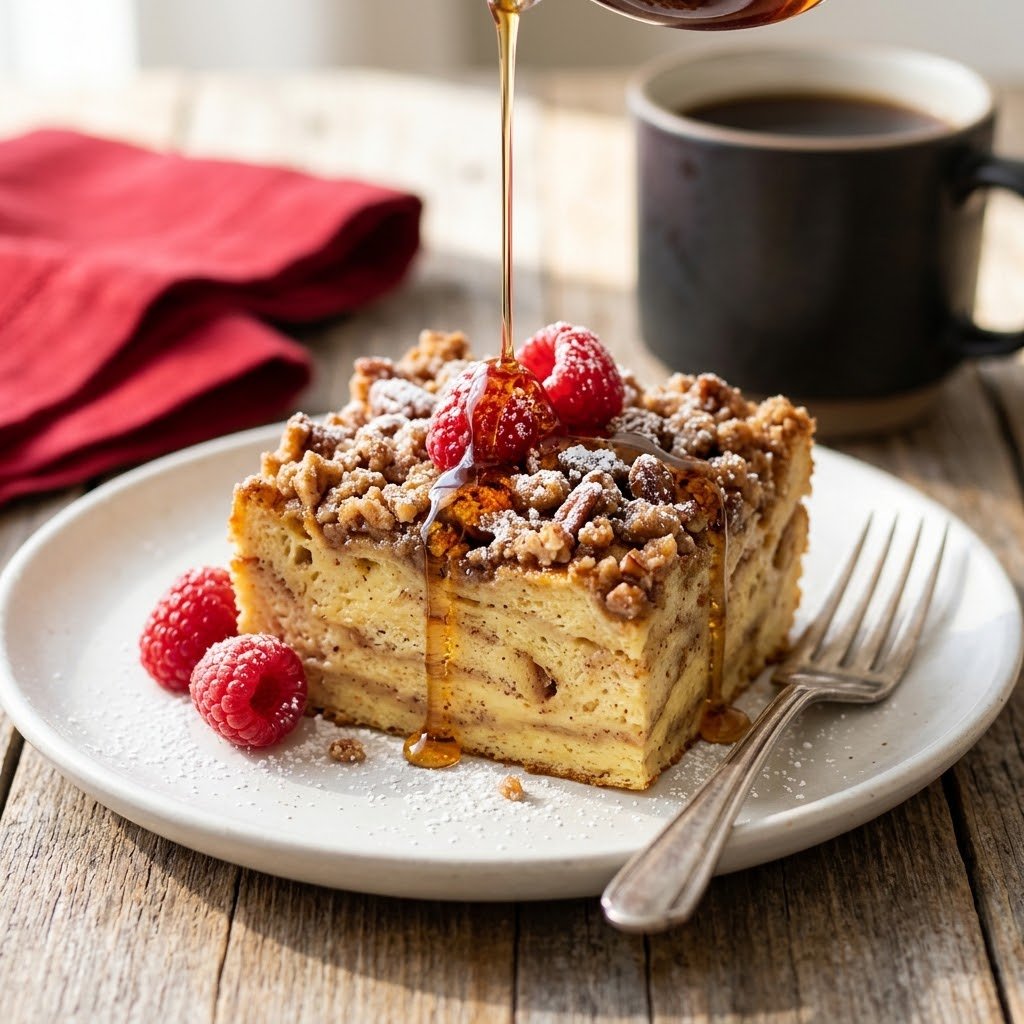
- Rest and serve. Let it rest 10 minutes so it slices cleanly, then serve with maple syrup, powdered sugar or berries.
Make-Ahead Timeline for Christmas Morning
| When | What to do |
|---|---|
| Up to 2 days before | Cube the bread and leave it out, loosely covered, to dry. |
| Night before | Assemble the casserole, make the crumble, refrigerate both. |
| 1 hour before eating | Set the casserole out; heat the oven to 350°F. |
| 50 minutes before eating | Add the crumble and bake. |
| At the table | Rest 10 minutes, slice, serve. |
Fixing the Common Problems
Soggy or wet in the middle
This usually comes from fresh bread, too much liquid for the amount of bread, or pulling it out too early. Use dry bread, measure the eggnog, and bake until the center reaches 160°F. If the top is browning before the middle is done, lay foil back over it and keep baking.
Dry pieces on top
Some cubes poke above the custard and toast in the oven, which many people like. If you want a softer top, press the bread down once more in the morning before adding the crumble, and keep the foil on for the first 20 minutes.
Too sweet
Eggnog brands vary a lot in sugar. If yours is very sweet, skip the brown sugar in the custard and keep it only in the crumble.
Variations to Try
- Cranberry orange: scatter 1 cup fresh or frozen cranberries between the bread cubes and add 1 teaspoon orange zest to the custard.
- No-nut topping: leave out the pecans, or use rolled oats in their place for crunch.
- Cinnamon swirl bread: use cinnamon swirl loaf instead of challah and cut the cinnamon in the custard in half.
- Smaller batch: halve everything and bake in an 8×8-inch pan for 35 to 45 minutes.
What to Serve With It
A salty side balances the sweet casserole: crisp bacon, breakfast sausage, or scrambled eggs. Fresh fruit and a pot of coffee finish the table. If you want something to drink that matches, our winter citrus syrup makes a quick spritzer, and for another breakfast idea try these Cracker Barrel-style French toast slices or a stack of fluffy homemade pancakes.
Storing and Reheating
Refrigerate leftovers within 2 hours of baking and eat them within 3 to 4 days, following the USDA guidance on leftovers. Reheat single portions in the microwave for 45 to 60 seconds, or warm the whole dish covered at 325°F for 15 to 20 minutes. Baked squares can be frozen, wrapped well, for up to 2 months, though the texture is softer after thawing.
Eggnog French Toast Casserole FAQ
Can I make eggnog french toast casserole the same morning?
Yes, but give it at least an hour of soaking, pressing the bread down a few times. The overnight version is more even, because the custard has time to reach the center of every cube.
Can I use homemade eggnog?
Yes, as long as it is fully chilled and fresh. Homemade eggnog is often thicker, so you may need the full half cup of milk or a little more to thin it.
What is the best bread for an overnight eggnog french toast bake?
Day-old challah or brioche. Sturdy French bread works too. Avoid soft sandwich bread, which turns mushy after a long soak.
How do I know when it is done?
The top is puffed and golden, a knife in the center comes out without liquid custard, and the center reads 160°F on an instant-read thermometer.
Can I freeze it before baking?
It is not recommended. The bread breaks down as it thaws. Assemble it the night before instead and freeze leftovers after baking if needed.
Ready to bake? The full ingredient amounts and steps are in the recipe card below, and you can print it straight from the card.
Eggnog French Toast Casserole
12
servings20
minutes50
minutes9
hours10
minutesAn overnight eggnog french toast casserole made with day-old challah, an eggnog custard, and a pecan crumble. Assemble the night before, bake in the morning.
Ingredients
- For the casserole
1 loaf (about 16 ounces) challah or brioche, day-old, cut into 1-inch cubes (about 12 cups)
8 large eggs
2 1/2 cups eggnog
1/2 cup whole milk
1/3 cup packed brown sugar
1 teaspoon vanilla extract
1/2 teaspoon ground cinnamon
1/2 teaspoon ground nutmeg
1/4 teaspoon salt
2 tablespoons rum or bourbon (optional)
Butter for the pan
- For the pecan crumble
1/2 cup all-purpose flour
1/2 cup packed brown sugar
1/2 teaspoon ground cinnamon
4 tablespoons cold unsalted butter, cubed
1/2 cup chopped pecans
- To serve
Maple syrup, powdered sugar or fresh berries
Directions
- Prepare the pan: Butter a 9×13-inch baking dish and spread the bread cubes in an even layer.
- Make the custard: Whisk the eggs well, then whisk in the eggnog, milk, brown sugar, vanilla, cinnamon, nutmeg, salt and rum if using.
- Soak: Pour the custard over the bread and press down so every piece is moistened. Cover and refrigerate at least 4 hours or overnight.
- Make the crumble: Mix flour, brown sugar and cinnamon, cut in the cold butter until crumbly, stir in pecans, and refrigerate covered.
- Warm up: In the morning, set the dish out for 30 minutes and heat the oven to 350°F.
- Bake: Scatter the crumble over the top. Bake covered with foil for 20 minutes, then uncovered for 25 to 35 minutes, until puffed, golden, and 160°F in the center.
- Rest and serve: Let rest 10 minutes, then slice and serve with maple syrup, powdered sugar or berries.
Notes
- Total time includes an 8-hour overnight soak; the minimum soak is 4 hours.
- Dry fresh bread at 300°F for 10 minutes before using.
- Refrigerate leftovers within 2 hours and eat within 3 to 4 days.
- For a smaller batch, halve the recipe and bake in an 8×8-inch pan for 35 to 45 minutes.